
WASILC CIEP Blog: 11172026
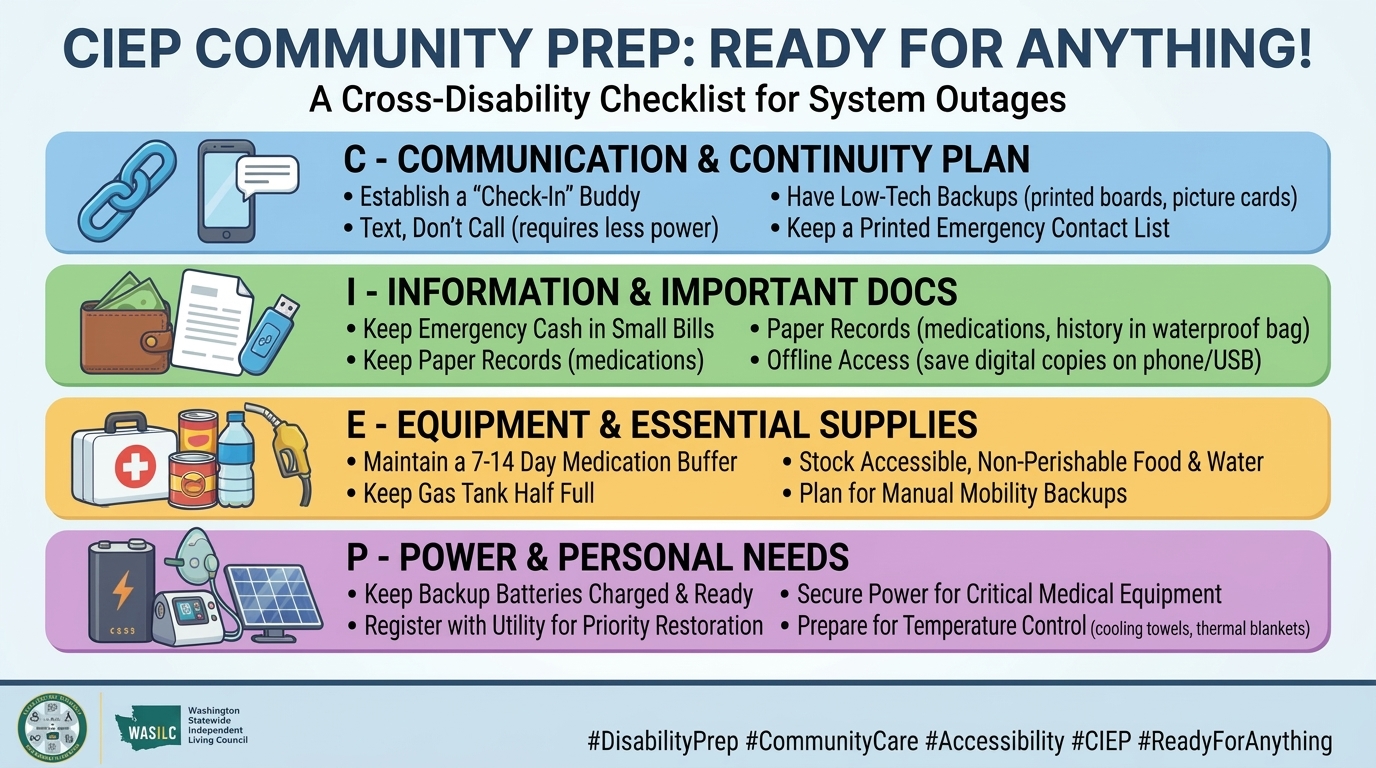
🌟 CIEP Community Prep: Ready for Anything! 🌟
Heads up, community! 📢 Temporary system outages can happen—whether it’s a power grid issue or a glitch affecting banks, grocery stores, or gas stations, or even planes.
Being prepared doesn’t mean panicking; it means we can handle disruptions safely and comfortably. Having a plan takes the stress out of the unknown. CIEP offers you a quick, cross-disability friendly checklist to make sure you have what you need when systems go down. Save this post and share it with your network! 💛
🗣️ C - COMMUNICATION & CONTINUITY PLAN
When phones and the internet are unreliable, how will we connect?
• The "Check-In" Buddy: Choose a trusted out-of-town contact. When local networks are jammed, long-distance texts often go through faster. Have a plan for who checks on who.
• Text, Don’t Call: Text messages require less battery and network data than voice calls.
• Low-Tech Backups: If you use an electronic AAC device, keep a printed communication board, picture cards, or a whiteboard on hand.
• Emergency List: Keep a printed list of emergency contacts, your care team, and local non-emergency dispatch numbers.
📂 I - INFORMATION & IMPORTANT DOCS
When banks, ATMs, and pharmacy systems are down, what do you need to keep on hand?
• Emergency Cash: Credit card readers and ATMs won’t work without power. Keep some cash in small bills ($1, $5, $10) for emergencies. Build up a cash reserve over time.
• Paper Records: Print a list of your current medications, dosages, baseline behaviors, and medical history. Keep a copy in a waterproof bag.
• Offline Access: Save copies of important documents and IDs locally on your phone so you can view them without Wi-Fi. Or store them in a password-protected USB drive.
🦽 E - EQUIPMENT & ESSENTIAL SUPPLIES
When gas stations and grocery stores are closed, what keeps us going?
• Medication Buffer: Aim to keep at least a 7- to 14-day backup supply of essential medications and medical supplies. Refill them early when possible!
• Accessible Food & Water: Stock up on non-perishable shelf-stable foods that you can open and eat. Focus on food and drinks that need no cooking, no power, and fit your sensory and dietary needs. Outdoor sports stores offer a great variety, or you can make your own.
• Keep the Tank Half Full: Gas pumps require electricity. Try not to let your vehicle (or accessible van) drop below half a tank of gas. Carry an emergency kit in your trunk.
• Manual Mobility: If you use a power wheelchair or scooter, have a manual backup chair if possible. Plan for safe transfers if your chair is damaged or loses its charge.
🔋 P - POWER & PERSONAL NEEDS
When the electricity is out, how do we run our gear?
• Backup Batteries: Keep power banks fully charged for communication devices, hearing aids, and smartphones. Solar or hand-crank chargers are great ways to maintain access to power.
• Medical Equipment: If you use life-sustaining equipment (CPAP, feeding pumps, oxygen, ventilators), invest in a portable power station or backup battery.
• Utility Priority: Contact your local power company today to register for their "Medical Baseline" or priority restoration program if you rely on electrically powered medical equipment.
• Temperature Control: Have cooling towels or battery-operated fans for heat, and thermal blankets for cold, especially if your disability affects body temperature regulation.
You’ve got this! Start small—pick one thing off this list to do this week. In a few weeks, you will be more prepared.
Together, we stay safe. 🤝💙
#DisabilityPrep #CommunityCare #Accessibility #EmergencyPreparedness #CrossDisability #CIEP #MutualAid #ReadyForAnything


